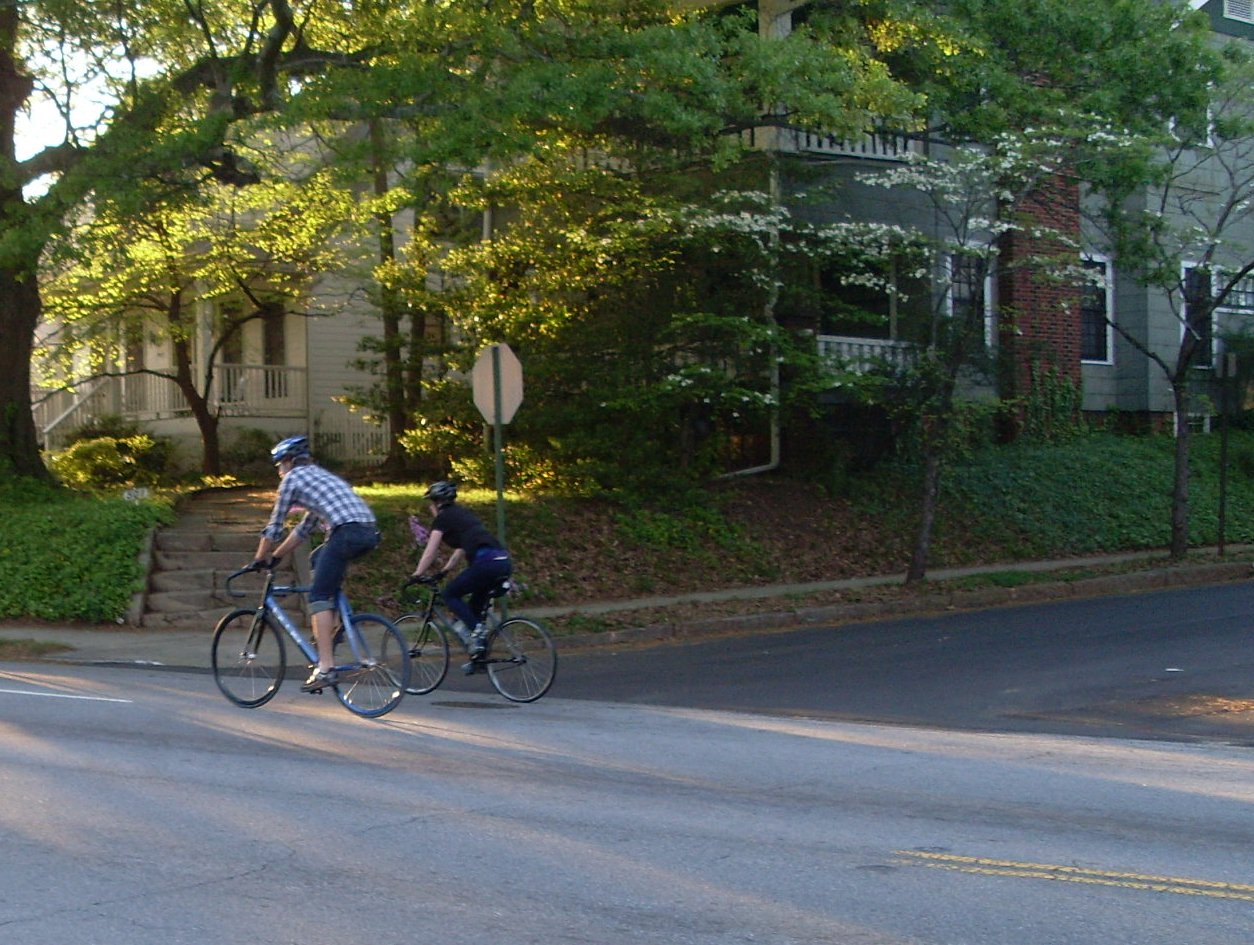
There has been a lot of commentary in the 'transportation choices' world about President Obama's speech on energy policy and independence from foreign oil. Basically, the president spoke for, oh, 30 minutes or so last week about energy security. After worrying about the economic and political implications of oil dependence, he went on to endorse oil exploration, more oil drilling, biofuels, natural gas vehicles, and electric cars. There was one brief mention of transit. And there was not a single mention of the millions of Americans who have already cut their oil consumption by a third, or perhaps much more, by walking and bicycling instead of driving.
The best article I have seen, which really sums up the discussion, was on Grist. This will give you a feel for the spectrum of debate, which ranges from "hey, you forgot something" to "oh no, we're all doomed".
We have plenty of oil-independent folks in Atlanta, and there seem to be more every day.
Showing posts with label optimism. Show all posts
Tuesday, April 5, 2011
Friday, November 5, 2010
Public Streets, Public Life
I know everyone is sick of hearing about politics, including me, so I won't address it directly. But I do want to make some observations about general concepts of political engagement and public discourse as they relate to urban form.
A few things struck me in New York City... One was the frequency with which I encountered parks, plazas, and community gardens. You didn't have to intentionally go to a park, you just kind of wound up in one on your way somewhere. There is Central Park, of course, an enormous presence throughout upper Manhattan. But there are also delightful public spaces crammed into every available spot. Benches and landscaping invite passerby to linger for a few extra minutes, and friends meet on street corners and near subway stations.
They are even reclaiming parts of the roadway, using planters, paint, and attractive fences to create places to walk and sit. (I'll describe how this affects bicycling in another post.)
The sidewalks themselves are enormous compared to most other cities. And with good reason; there are thousands - millions? - of people using them all day and night. I can't even guess how many people I came face-to-face with in the day I spent walking around. There are social norms in place so that you limit your actual interaction with others to a manageable level, such as not quite making eye contact. But you can interact if you want to, especially with people you encounter regularly. No matter what, you realize that you are in a diverse community but still have much in common with its members.
This opportunity for interaction is largely lacking in Atlanta, and people are noticing. At a recent meeting, one person after another said, in their own ways, "We don't have a public life in the Atlanta region. We don't have public places to meet, to express ourselves to the community, to interact with people who aren't exactly like us, to create a society. Everything is gated, commercialized, privatized. There is no commons."
One of the facts I heard about NYC, while I was there at my conference, was that 80% of their public space is their streets. This includes the sidewalks and bikeways. So the way that they use that space is crucial for creating a society, a public realm. I would assume the figures are similar for Atlanta's public space, but ours in almost entirely used for motor vehicles. You can't interact from a car. Honking and shouting are not a basis for community. Even rolling the window down to talk to a neighbor feels somewhat divisive, as you strain your voice over the sound of the motor and continually glance behind you for approaching traffic. And although local streets make up most of the transportation network, the majority of car travel takes place on major roads and highways where no meaningful interaction is possible at all.
How does this affect our perception of society? Will we support different public policies as a result? Does it change our perception of our role in the political system? Does it limit our ability to get unbiased information about the world around us? And if it is changing our sense of community for the worse, what can we do about it? Will we have the strength to change the existing policies, and create a new social and political future?
A few things struck me in New York City... One was the frequency with which I encountered parks, plazas, and community gardens. You didn't have to intentionally go to a park, you just kind of wound up in one on your way somewhere. There is Central Park, of course, an enormous presence throughout upper Manhattan. But there are also delightful public spaces crammed into every available spot. Benches and landscaping invite passerby to linger for a few extra minutes, and friends meet on street corners and near subway stations.
![]() |
| Park benches and gardens line the Broadway median |
| A cyclist greets friends at Union Square |
| Moments of beauty in everyday life |
They are even reclaiming parts of the roadway, using planters, paint, and attractive fences to create places to walk and sit. (I'll describe how this affects bicycling in another post.)
The sidewalks themselves are enormous compared to most other cities. And with good reason; there are thousands - millions? - of people using them all day and night. I can't even guess how many people I came face-to-face with in the day I spent walking around. There are social norms in place so that you limit your actual interaction with others to a manageable level, such as not quite making eye contact. But you can interact if you want to, especially with people you encounter regularly. No matter what, you realize that you are in a diverse community but still have much in common with its members.
This opportunity for interaction is largely lacking in Atlanta, and people are noticing. At a recent meeting, one person after another said, in their own ways, "We don't have a public life in the Atlanta region. We don't have public places to meet, to express ourselves to the community, to interact with people who aren't exactly like us, to create a society. Everything is gated, commercialized, privatized. There is no commons."
One of the facts I heard about NYC, while I was there at my conference, was that 80% of their public space is their streets. This includes the sidewalks and bikeways. So the way that they use that space is crucial for creating a society, a public realm. I would assume the figures are similar for Atlanta's public space, but ours in almost entirely used for motor vehicles. You can't interact from a car. Honking and shouting are not a basis for community. Even rolling the window down to talk to a neighbor feels somewhat divisive, as you strain your voice over the sound of the motor and continually glance behind you for approaching traffic. And although local streets make up most of the transportation network, the majority of car travel takes place on major roads and highways where no meaningful interaction is possible at all.
How does this affect our perception of society? Will we support different public policies as a result? Does it change our perception of our role in the political system? Does it limit our ability to get unbiased information about the world around us? And if it is changing our sense of community for the worse, what can we do about it? Will we have the strength to change the existing policies, and create a new social and political future?
| The High Line: NYC created a new park on elevated train tracks several stories off the ground |
Friday, September 17, 2010
Bicycling is Contagious
I was quite surprised to learn that two of my neighbors cycled to work today. They'd always been so skeptical of my habits. This comes on top of lots of other promising signs - people who used to ask if a store had free parking now point out that it's easy to bike there. Random folks ask how they can start getting around by bicycle. And I see more and more folks riding around in ordinary work and dress clothes.
You absolutely would not have seen this a year ago in Atlanta. Maybe the occasional rarity, but not every time you stepped outside. I have to wonder where their inspiration came from. Did they just feel like wearing nice clothes and riding a bike, out of the blue? Did they see something on TV or read a blog? Are their friends doing it? Whatever it is, it seems to be spreading rapidly. Could this be you?
Thursday, August 19, 2010
Addendum to Society, Image, and Change
In yesterday's post, I failed to mention the most outrageous anti-bicycle sentiment of all - the Colorado gubernatorial candidate who claims that bike share programs are an international conspiracy to deprive Americans of their "personal freedoms"! At least this guy's wackiness is obvious to the average American.
I also came across a thought-provoking post on Bikehugger, asking if there are fundamental differences between the U.S. and countries with better bicycling policies, like Denmark and the Netherlands. I would say that yes, there are fundamental differences. But that they don't stop us from adopting bicycling, they just mean that we will go about it differently.
Bikehugger also captures a perfect example of the "how dare you interfere with my reckless driving privilege?" attitude. This really supports my belief that motorist anger toward bicycles actually stems from fears about their own ability to share the road.
Craziness abounds, but here in Atlanta we're doing just fine.
I also came across a thought-provoking post on Bikehugger, asking if there are fundamental differences between the U.S. and countries with better bicycling policies, like Denmark and the Netherlands. I would say that yes, there are fundamental differences. But that they don't stop us from adopting bicycling, they just mean that we will go about it differently.
Bikehugger also captures a perfect example of the "how dare you interfere with my reckless driving privilege?" attitude. This really supports my belief that motorist anger toward bicycles actually stems from fears about their own ability to share the road.
Craziness abounds, but here in Atlanta we're doing just fine.
Friday, August 13, 2010
Chatty Thursday
Yesterday was unusually friendly for some reason. There was the sporty cyclist who made conversation at the red light, before sprinting away on the green. And then there were at least 3 pedestrians who said 'hi' or 'hey baby' or something as I passed them. I even had a few greetings from nearby motorists. Very unusual!
Maybe the Raleigh, which I've been riding most of the week, seems friendlier than other bicycles. I don't have time to respond to any of this, unless I'm at a light, but I kind of like it. It emphasizes the different effect that bicycles have on the social environment relative to cars. Cars are kind of impersonal. If you stand next to a road full of cars, you don't get the sense that any other people are nearby, even though they are just a few feet away. But if you stand next to a busy bicycle lane or path, you see lots of people and it feels very connected even if you don't actually interact in any way.
Wednesday, July 21, 2010
Flexibility
Cars are expensive and hard to repair. When something goes wrong with the car of my co-worker, who lives way out in Woodstock, she has to call in to work. In these cases, she can miss half a day of work while trying to get it towed and find some other way to the office.
Bicycle repairs are inexpensive and can often be performed at home. You don't have to have your bicycle towed to the shop. Best of all, bicycles are cheap and easy to store - get a few! If one bicycle breaks down - or if you wake up to discover a flat tire - you can just take the other one. At worst, maybe you take the bus or the train.
I was really looking forward to riding the Raleigh on Tuesday. I even picked out a cute outfit that would coordinate with its metallic brown paint. But the front tire was flat... No problem, I just grabbed Blue Belle and headed off to vote in the Georgia primaries. Note that she is still wearing the bow that came on one of my birthday presents last week!
Bicycle repairs are inexpensive and can often be performed at home. You don't have to have your bicycle towed to the shop. Best of all, bicycles are cheap and easy to store - get a few! If one bicycle breaks down - or if you wake up to discover a flat tire - you can just take the other one. At worst, maybe you take the bus or the train.
I was really looking forward to riding the Raleigh on Tuesday. I even picked out a cute outfit that would coordinate with its metallic brown paint. But the front tire was flat... No problem, I just grabbed Blue Belle and headed off to vote in the Georgia primaries. Note that she is still wearing the bow that came on one of my birthday presents last week!
Sunday, July 4, 2010
Traffic Mood Swings
Atlanta traffic has mood swings like a sensitive person. Rain makes everyone testy, heat makes them feel charitable. A holiday weekend gets people ready to party. Sometimes this can make for interesting traffic. By Friday afternoon, many families had left town for a Fourth of July vacation. The streets were wide open. Everyone else was happy to be leaving work and ready to start the weekend. This made for some impatient drivers, and a few raucous young men who hollered something unintelligible at me. I never felt that there was any unsafe behavior though, at least not around me. And still more bicycles keep appearing on the road. Happy Independence Day!
Friday, June 4, 2010
Takeoff
The first launch out of my driveway in the morning is always such a pleasure. I roll the bicycle down my porch steps and walk it down to the end of the driveway. After making sure all my stuff is in place, I slide onto the saddle and start rolling. The slope of the driveway accelerates me gently into the street - and I smile. I can't help it, I always smile. It's such a wonderful feeling, like the little rush you get at the top of a ferris wheel. And after that, there may be hills and traffic, but I started the day with a smile.
Wednesday, May 26, 2010
Just Smile and Nod
I've occasionally ribbed on motorists for being too confrontational - trying to go faster everyone else, often taking major risks in their quest for the front of the line. But lately, my beliefs have been challenged. And I may be just as bad when I'm on my bike.
I'm in the habit of yelling when a car seems poised to cut me off or potentially hit me. I am also the master of the intimidating stare. This week, however, the response from drivers has been friendly waves, smiles, and polite comments like "Don't worry, I'll wait for you." Wha??
I feel kind of disoriented. Is there something in the water? Did everyone watch footage of Streets Alive, and the sight filled their heads with love and rainbows about bicycling?
At the same time, bicycling has been all over the news. Creative Loafing devoted this week's Add it Up column to cycling. Examiner.com asked about the "state of cycling in Atlanta."
So what's up? Am I reading too much into some random events, or has Atlanta turned a corner on bicycle traffic?
I'm in the habit of yelling when a car seems poised to cut me off or potentially hit me. I am also the master of the intimidating stare. This week, however, the response from drivers has been friendly waves, smiles, and polite comments like "Don't worry, I'll wait for you." Wha??
I feel kind of disoriented. Is there something in the water? Did everyone watch footage of Streets Alive, and the sight filled their heads with love and rainbows about bicycling?
At the same time, bicycling has been all over the news. Creative Loafing devoted this week's Add it Up column to cycling. Examiner.com asked about the "state of cycling in Atlanta."
So what's up? Am I reading too much into some random events, or has Atlanta turned a corner on bicycle traffic?
Thursday, May 13, 2010
Happy Anniversary, Bicycle!
My memory isn't great, but I'm fairly sure that I bought my first bicycle (ever) in May of 2004. Six years! As I've mentioned before, I never rode a bike as a child. My parents bought me a pretty pink cruiser with flowers all over it and a basket on the front. They took me out and tried to teach me how to ride it. But I just couldn't get the hang of it. I gave up after a couple of unsuccessful tries. I didn't feel particularly motivated to learn since none of my friends rode bicycles either, and my parents' matching set of yellow 10-speeds never left the basement. Not that we were lazy or anything - there was tons of walking and hiking - but not really into bicycles.
This all changed once I moved to Atlanta and had a lot of friends who cycled around town. I resolved to get a bike and learn to ride it. I had ridden a motorcycle through most of my college years, so I felt pretty confident in my ability to master a two-wheeled contraption with pedals instead of a throttle.
At first, I could barely get up hills, and riding more than a mile or two made my whole body hurt. I had no idea how to interact with cars and I even rode on the sidewalk. But I kept trying. I had been taking a commuter bus to work a couple days a week. With the bicycle, I could make connections faster, so my transit commute was easier. Eventually I was driving only one day a week (I worked near the Smyrna/Cumberland Mall area) and taking my bicycle on the bus the rest of the time. I was so proud of myself the first time I rode up clock tower hill on Cobb Parkway without stopping! Cobb Parkway is really busy but that section has a wide shoulder that is fairly easy to use...
There were all sorts of incidents and learning experiences. My fender blew off one time when my bike was on the front rack of the bus, as it was heading up the interstate. I fell, swerving to avoid a turning car, and skinned my knee. I learned which clothes would stay unwrinkled in my bag and which shoes had enough traction to stay on my pedals. On a trip to Germany, on a rented European city bike and riverside bicycle paths, I discovered the joys of upright, fully equipped cycling.
Eventually, I decided to go back to school. Instead of riding the bus OTP (outside the perimeter), I was now cycling a couple of miles to downtown Atlanta. I discovered that my little aluminum mountain bike didn't really have the qualifications of a good road bike, and went shopping. I acquired Blue Belle, my pretty blue roadster. I learned from blogs around the world that lots of people like these practical, graceful bicycles. And I finally learned how to ride gracefully, in style.
Now, it has been six years. I have been cycling to work at least 3 days a week for six years, not to mention shopping, dining, etc. The funny thing is how many people - motorists - would say that it's impossible to get anywhere by bicycle. How is it that I've been doing something rumored to be so difficult for so long? Have I made any impression at all on the thousands, maybe hundreds of thousands, of drivers who saw me along their commute or at the grocery store? How can people be so disbelieving?
But on the positive side, many more people do believe now. The number of people riding bicycles - including many influential people - is growing faster than I ever could have imagined. Where will things be by next year?
This all changed once I moved to Atlanta and had a lot of friends who cycled around town. I resolved to get a bike and learn to ride it. I had ridden a motorcycle through most of my college years, so I felt pretty confident in my ability to master a two-wheeled contraption with pedals instead of a throttle.
At first, I could barely get up hills, and riding more than a mile or two made my whole body hurt. I had no idea how to interact with cars and I even rode on the sidewalk. But I kept trying. I had been taking a commuter bus to work a couple days a week. With the bicycle, I could make connections faster, so my transit commute was easier. Eventually I was driving only one day a week (I worked near the Smyrna/Cumberland Mall area) and taking my bicycle on the bus the rest of the time. I was so proud of myself the first time I rode up clock tower hill on Cobb Parkway without stopping! Cobb Parkway is really busy but that section has a wide shoulder that is fairly easy to use...
There were all sorts of incidents and learning experiences. My fender blew off one time when my bike was on the front rack of the bus, as it was heading up the interstate. I fell, swerving to avoid a turning car, and skinned my knee. I learned which clothes would stay unwrinkled in my bag and which shoes had enough traction to stay on my pedals. On a trip to Germany, on a rented European city bike and riverside bicycle paths, I discovered the joys of upright, fully equipped cycling.
Eventually, I decided to go back to school. Instead of riding the bus OTP (outside the perimeter), I was now cycling a couple of miles to downtown Atlanta. I discovered that my little aluminum mountain bike didn't really have the qualifications of a good road bike, and went shopping. I acquired Blue Belle, my pretty blue roadster. I learned from blogs around the world that lots of people like these practical, graceful bicycles. And I finally learned how to ride gracefully, in style.
Now, it has been six years. I have been cycling to work at least 3 days a week for six years, not to mention shopping, dining, etc. The funny thing is how many people - motorists - would say that it's impossible to get anywhere by bicycle. How is it that I've been doing something rumored to be so difficult for so long? Have I made any impression at all on the thousands, maybe hundreds of thousands, of drivers who saw me along their commute or at the grocery store? How can people be so disbelieving?
But on the positive side, many more people do believe now. The number of people riding bicycles - including many influential people - is growing faster than I ever could have imagined. Where will things be by next year?
Wednesday, May 12, 2010
Back to Civilization
Traveling last weekend was a lot of fun, but lots of highway time... And Atlanta is definitely one of the best cities in Georgia for bicycling, walking, and generally having a real intown lifestyle. I hear Savannah is doing well, but haven't been there in a few years. Anyway, it was a relief to get back to our bustling sidewalks, passing bicycles, friendly neighbors, and thriving businesses!
Wednesday, April 28, 2010
Transportation, Recreation, and Cash
There's a lot going on in the transportation scene in Georgia. Whether it's positive for state residents remains to be seen. The state legislature has passed a bill that permits multiple counties to vote on a regional transportation tax. You sort of have to wonder why this would have been prohibited to begin with...but Georgia is very anti-tax. The bill still has disadvantages. It stipulates a 10-year sunset, which makes it much harder to use for transit projects due to federal requirements. But at least transit is an allowable use! Unlike the gas tax. Also, the state DOT has much more control over the regional project list than seems reasonable.
How might this affect cycling? It could be bad if a lot of the funding goes to new bicycle-unfriendly highways or highway conversions. Or, it could be good if it pays for lots of new bicycle (and pedestrian) facilities, or the redesign of dangerous roads.
So what are the odds? So far, the DOT has argued that bicycle facilities were not eligible for gas tax funding, which was limited to "roads and bridges". However, roads are legally defined as any transportation facility and it doesn't actually limit funding to roads that service cars (not that this little detail has led to any extra funding for bicycle stuff). It does include bicycle lanes or sidewalks that are part of a larger "road or bridge" project. Will this attitude be extended to the new funding?
One of the main arguments for treating bicycle-only facilities differently is that it is not "real" transportation. Obviously, this is ridiculous. I've bicycled to work the majority of the time for about the past five years. And to the store, restaurant, friends houses, and everywhere else, and so have many other folks. I do most of this on city streets, not on bicycle paths. But there are plenty of people who do use paths for their commute or other travels, if it happens to be on their way.
There is also an awful lot of recreational travel, by every different mode, and that isn't a bad thing. Some people go out for a sunday drive, take a stroll, go sightseeing, or take a scenic route on their bicycle. Pretty soon, they get hungry, they stop at a restaurant, pop into a store, and boost the economy. It's an important part of life and use of our transportation infrastructure.
Then there is tons of travel that doesn't fall neatly into either category. If you stop to eat during your sunday drive, does it suddenly become a transportation trip to a restaurant? If you stop to enjoy the sunset during your bicycle trip home from work, or pedal a little harder to get some exercise, does it become recreational?
And finally, the big question: if a transportation facility is carrying an unusually large proportion of one type of trip or the other, why? And should we care? If most of the trips taken on the Silver Comet Trail are recreational, does it simply mean that it doesn't provide access to common destinations? Does it fail to connect to nearby stores and town centers? That would be like building a big highway with exits that lead to bumpy dirt roads. It discourages transportation. On the other hand, if we build highways that are stressful and ugly and only used out of necessity, those facilities may discourage recreational travel, and thus depress economic activity.
Ultimately, it is due time to support all types of travel for all reasons. The feds may have finally learned this. Has Georgia?
How might this affect cycling? It could be bad if a lot of the funding goes to new bicycle-unfriendly highways or highway conversions. Or, it could be good if it pays for lots of new bicycle (and pedestrian) facilities, or the redesign of dangerous roads.
So what are the odds? So far, the DOT has argued that bicycle facilities were not eligible for gas tax funding, which was limited to "roads and bridges". However, roads are legally defined as any transportation facility and it doesn't actually limit funding to roads that service cars (not that this little detail has led to any extra funding for bicycle stuff). It does include bicycle lanes or sidewalks that are part of a larger "road or bridge" project. Will this attitude be extended to the new funding?
One of the main arguments for treating bicycle-only facilities differently is that it is not "real" transportation. Obviously, this is ridiculous. I've bicycled to work the majority of the time for about the past five years. And to the store, restaurant, friends houses, and everywhere else, and so have many other folks. I do most of this on city streets, not on bicycle paths. But there are plenty of people who do use paths for their commute or other travels, if it happens to be on their way.
There is also an awful lot of recreational travel, by every different mode, and that isn't a bad thing. Some people go out for a sunday drive, take a stroll, go sightseeing, or take a scenic route on their bicycle. Pretty soon, they get hungry, they stop at a restaurant, pop into a store, and boost the economy. It's an important part of life and use of our transportation infrastructure.
Then there is tons of travel that doesn't fall neatly into either category. If you stop to eat during your sunday drive, does it suddenly become a transportation trip to a restaurant? If you stop to enjoy the sunset during your bicycle trip home from work, or pedal a little harder to get some exercise, does it become recreational?
Cyclists and pedestrians want convenient access to stores and services
And finally, the big question: if a transportation facility is carrying an unusually large proportion of one type of trip or the other, why? And should we care? If most of the trips taken on the Silver Comet Trail are recreational, does it simply mean that it doesn't provide access to common destinations? Does it fail to connect to nearby stores and town centers? That would be like building a big highway with exits that lead to bumpy dirt roads. It discourages transportation. On the other hand, if we build highways that are stressful and ugly and only used out of necessity, those facilities may discourage recreational travel, and thus depress economic activity.
A couple rides along a four lane road, not the adjacent multi-use path with poor access & design
Ultimately, it is due time to support all types of travel for all reasons. The feds may have finally learned this. Has Georgia?
Tuesday, March 23, 2010
Dispersion
There are some parts of town where the bicycle culture is really thriving - around university campuses, in the Little Five Points, East Atlanta, and Decatur communities. In the rest of the city, cyclists are much less common. And the ones you do see appear to be athletes, or people who have limited means and alternatives.
I think we need to respect and embrace everyone who rides a bicycle, regardless of the circumstances. But I also believe that people riding bicycles by choice as a part of their daily activities are the indicator of real bicycle culture. So I have been very happy to spot some fashionable and confident urban cyclists in new areas of town.
For example, in the Turner Field area. First I spotted a guy at night, with great lights and a snazzy silver city bike, zipping by in a business suit. A few days later, the gentleman above, cruising along in the bike lane and listening to some music. And a couple days after that, a fabulous guy in khackis, coat, and a pageboy cap. Obviously, I need to be more prepared to snap photos anywhere, anytime! And hopefully a few women and children will start appearing...
I think we need to respect and embrace everyone who rides a bicycle, regardless of the circumstances. But I also believe that people riding bicycles by choice as a part of their daily activities are the indicator of real bicycle culture. So I have been very happy to spot some fashionable and confident urban cyclists in new areas of town.
For example, in the Turner Field area. First I spotted a guy at night, with great lights and a snazzy silver city bike, zipping by in a business suit. A few days later, the gentleman above, cruising along in the bike lane and listening to some music. And a couple days after that, a fabulous guy in khackis, coat, and a pageboy cap. Obviously, I need to be more prepared to snap photos anywhere, anytime! And hopefully a few women and children will start appearing...
Monday, March 8, 2010
Summer Fever
72 degrees!
Today was a beautiful, summery day. Such a shame to be inside at the office. But then, a lovely ride home.
However, the weather seemed to make everyone else squirrely. I heard the first yelling motorist in months. She was yelling not just at me, but at the cars in front of her as well. How dare we travel on her road, make turns, and stop at traffic lights! Whatever. Maybe they've been yelling the whole time, and I just couldn't hear them because their windows were rolled up... But more likely, people are feeling cooped up in their cars. I know traffic has been bad for motorists lately, especially on the expressways. In addition to pent-up driver frustrations, there were also blissful pedestrians crossing the road without looking, people taking a drive around the block in junky cars that could barely move, and a few misbehaving bicyclists. Alas.
Fortunately, the weather was too nice to worry about all that. It's better to notice the sun on your face and the breeze on your skin.
Today was a beautiful, summery day. Such a shame to be inside at the office. But then, a lovely ride home.
However, the weather seemed to make everyone else squirrely. I heard the first yelling motorist in months. She was yelling not just at me, but at the cars in front of her as well. How dare we travel on her road, make turns, and stop at traffic lights! Whatever. Maybe they've been yelling the whole time, and I just couldn't hear them because their windows were rolled up... But more likely, people are feeling cooped up in their cars. I know traffic has been bad for motorists lately, especially on the expressways. In addition to pent-up driver frustrations, there were also blissful pedestrians crossing the road without looking, people taking a drive around the block in junky cars that could barely move, and a few misbehaving bicyclists. Alas.
Fortunately, the weather was too nice to worry about all that. It's better to notice the sun on your face and the breeze on your skin.
Monday, February 22, 2010
Year of the Bicycle
Some local bicycle advocates have wistfully named 2010 the "Year of the Bicycle" in Atlanta. They may be right. I have been astounded at the amount of bicycle traffic on the streets, now that the weather is warming up. There are smart, everyday cyclists everywhere. A few people are running lights or riding on sidewalks (not good), but most are just riding like they've always been a part of Atlanta traffic. I'm thrilled!
Friday, February 19, 2010
Where are the children?
There are at least 3 children who travel to school by bicycle in the Atlanta area - I know because I have seen them! My morning schedule took me past the bicycle path in Decatur. First two young boys pedaled by, talking happily. Then a slightly older boy rode past, looking relaxed. The age range was maybe from 7 or 8 up to age 12. I didn't have a chance to take any photos.
You rarely see children bicycling by themselves, for transportation, in Atlanta. You may see them riding around the neighborhood or occasionally on a group ride with their parents. Bicycle infrastructure seems to be particularly important for children. While an experienced adult cyclist may be comfortable riding in traffic, children (and their parents) may not be. But riding a bike is how kids can grow up healthy, confident, and independent. This is the biggest argument for a network of well-designed bicycle lanes, tracks, and paths.
Credit: Dave Horton http://thinkingaboutcycling.wordpress.com
Tuesday, February 9, 2010
One Cyclist at a Time
It turned out that she was headed to the same meeting, to make a presentation on bicycling and health. She covered all the important points - physical activity, clean air, community interaction. She added that, through their property taxes, cyclists overpay for their use of the road while subsidizing drivers. She also pointed out the enormous safety benefits. As more people ride bicycles:
- the rate of traffic injuries for bicyclists drops.
- the volume of car traffic drops.
- it is perceived as a safer and more common mode of travel.
Keep talking, Rebecca. One by one, people will be inspired by you, by a friend, by a photograph, by their own dissatisfaction with life confined to a car. And that person will inspire a friend or neighbor... It's already happening. As Rebecca told us, ABC's biannual bicycle counts show more people riding every year.
Sunday, February 7, 2010
Weekend Interludes
So, once again, another weekend has gone by. And once again, I have been too busy with errands, social engagements, and such to write a post. The sad truth is that I don't get to bicycle much on the weekends. Sometimes I am home working on a project or baking all day, sometimes I am running major errands for which I have to use a car...things come up. By the end of the weekend, I really feel like something is missing.
One strategy has been to stash my old mountain bike over at the Beau's house. Now, if I go over there for dinner or en route to meet friends that live over his way, I can arrive by train or car and still have something to ride! I tried it out this weekend. Much better. If we want to run out to the pub or visit friends, I'm not forced to go in a car, nor limited to walking distance. It's not particularly comfortable to ride and it has this flashy, sporty aesthetic that I really dislike, but hey...at least I'm under pedal power.
Your local pub - more fun when you enjoy fresh air and starry skies on the way...
Saturday, January 23, 2010
The Opposite of Aggressive Driving
We often dwell on negative encounters between motorists and bicyclists. And it certainly is angering. It seems so wrong, so brutal that someone could show such disregard for human life. That they could be so casual about the dangers posed by their 2 tons of speeding metal.
But for each of these instances, there are countless positive encounters. I can't remember the last time someone said or did something hostile toward me. (Knock on wood!) Instead, the drivers I encounter leave enough distance when they pass me, they wave me into traffic, they slow down so I can merge into their lane when mine is blocked. They say 'good morning'. At worst, they just treat me like another vehicle.
Is this a change in local attitude? Do I look like a nice girl that they want to help out? I don't know. Cascadina says that she was getting honked at until she started carrying her son around in a bike trailer. Now she gets waves and lots of questions. Anyone else noticing a change in attitude? The last time I encountered this kind of treatment, at least stateside, was a 2005 trip to Chicago.
But for each of these instances, there are countless positive encounters. I can't remember the last time someone said or did something hostile toward me. (Knock on wood!) Instead, the drivers I encounter leave enough distance when they pass me, they wave me into traffic, they slow down so I can merge into their lane when mine is blocked. They say 'good morning'. At worst, they just treat me like another vehicle.
Is this a change in local attitude? Do I look like a nice girl that they want to help out? I don't know. Cascadina says that she was getting honked at until she started carrying her son around in a bike trailer. Now she gets waves and lots of questions. Anyone else noticing a change in attitude? The last time I encountered this kind of treatment, at least stateside, was a 2005 trip to Chicago.
Bicycle route from Logan Square to the Loop
Thursday, January 21, 2010
Everybody's Talking
The hot topic seems to be redesigning American cities for cycling. We are starting almost from scratch, at least in most cities, which makes the task seem impossible. Two articles caught my eye today (via Twitter and Planetizen).
First up is an article in Governing Magazine, "Cities for Cycling Embrace European Street Designs". This highlight Cities for Cycling's attempt to transfer knowledge of bicycle infrastructure to cities that need it. Their source are both American and European.
Second, is Miller-McCune, a research news aggregator, who covered a meeting of the Transportation Research Board, or TRB. TRB is a branch of the National Academies of Science, making it a quasi-federal entity. This too compares US and European cities, particularly Copenhagen where our climate scientists and politicians recently traveled.
I can only hope that all of these experts and reporters have started with a review of John Pucher's "Making Cycling Irresistible: Lessons from The Netherlands, Denmark and Germany", a fantastic review of infrastructure, promotion, and enforcement strategies that increase cycling. I should also point out that it's not just infrastructure. If half of the people who drove to work today rode their bicycle to work tomorrow, the streets would feel very different. And the rest still drove, or walked, or took transit. We could have the exact same streets, but they would feel safe, lively, and much less congested...
It's a lovely thought, but as Pucher points out, many people will only choose their bicycle if the infrastructure is present. Let's build it!
First up is an article in Governing Magazine, "Cities for Cycling Embrace European Street Designs". This highlight Cities for Cycling's attempt to transfer knowledge of bicycle infrastructure to cities that need it. Their source are both American and European.
Second, is Miller-McCune, a research news aggregator, who covered a meeting of the Transportation Research Board, or TRB. TRB is a branch of the National Academies of Science, making it a quasi-federal entity. This too compares US and European cities, particularly Copenhagen where our climate scientists and politicians recently traveled.
I can only hope that all of these experts and reporters have started with a review of John Pucher's "Making Cycling Irresistible: Lessons from The Netherlands, Denmark and Germany", a fantastic review of infrastructure, promotion, and enforcement strategies that increase cycling. I should also point out that it's not just infrastructure. If half of the people who drove to work today rode their bicycle to work tomorrow, the streets would feel very different. And the rest still drove, or walked, or took transit. We could have the exact same streets, but they would feel safe, lively, and much less congested...
It's a lovely thought, but as Pucher points out, many people will only choose their bicycle if the infrastructure is present. Let's build it!
Subscribe to:
Posts (Atom)