Showing posts with label rant. Show all posts

Monday, November 14, 2011

Recreation or Transportation?

A while back, I came across another gem in the circular logic of suppressing transportation cycling by denying transportation funds to bicycle projects, based on the argument that it might be used for "recreation". From Sustainable Savannah.

This is something that really makes no sense to me in the development of cycling facilities. If you look at many of the bicycle or shared trails that have been built recently, it's obvious that it is quite difficult to use them for transportation. For instance, the Silver Comet trail runs parallel to US Highway 278 for a ways. 278 is lined with shopping centers and apartment complexes. The trail could serve to connect nearby residents to stores and restaurants, or to connect commuters from their condo or subdivision to "park and ride" lots. But there are hardly any connections that actually go to the shopping centers or residential complexes. The few roads that intersect the path have no bike lanes or shoulders, and no sidewalks for kids or for trail users on foot; they feature high speed traffic and deceleration lanes. There are no facilities along busy Highway 278 itself, if your destination doesn't happen to be right at the corner. So what happens? People put their bicycle onto a rack on their car, drive to the trail, ride back and forth, and leave. A few families who live near the trail ride around on it for an hour. The transportation potential, and potential economic impact, is mostly squandered. It's like building a huge expressway, but with exits that connect to dirt service roads that can only be traveled with a four-wheel drive truck, even though there are towns and stores less than a mile away. Would you be surprised if such an expressway saw little functional usage?
Silver Comet Trail, shown in red, near junction of US278 and GA92

Another example that shows the "trails aren't transportation" mindset of their planners is along Freedom Path in northeast Atlanta. Some parts of the path are pretty appealing - you can zip from the upper edge of the Sweet Auburn district over to the lower limits of Virginia Highland on a bicycle expressway that dodges under and around intersecting streets. But east of Moreland Ave, the arrangement falls apart. Here, North Avenue acts as the expressway, a direct and relatively shady route connecting to a major route to Emory University. But if you stay on the path, you'll travel at least twice the distance on a hot, shadeless hillside. You can't see the topography in the following image, but you'll also add several hundred feet in elevation change for yourself. It would be fine as an alternative sidepath to the direct main route, a scenic detour, or an option for people who are trying to work up a sweat rather than get to work. But as the only bicycle facility in this corridor, it's a failure. This path was not intended for going anywhere fast.
Freedom Path near junction of North Ave. and Oakdale Rd.

Wednesday, April 13, 2011

The Dark Side of Spring

Spring almost always evokes a joyful time - the hard winter is over, flowers are blooming, birds chirping, bees are mating, and soon the villagers will go out and plant sorghum or something. In Atlanta, however, the relationship with spring is more ambiguous. For one thing, the winters are pretty mild and the first flowers appear in February. And while the spring is beautiful, it also means that another long, hot, muggy summer is on the horizon. Then there is the pollen. I don't have a problem with it (knock on wood!) but many people do. For at least a month, people are obsessing over daily pollen counts and even staying home from work.

And then there are the new bicycle riders of spring. Every year, people who haven't ridden a bike since they were 10 come creaking out of their driveways. Now, I am really happy to see new riders in general. I think people should just get out there and start traversing the city by bicycle regardless of age, experience, or current physical activity level. But not regardless of traffic rules.

Yes, you were allowed to ride on the sidewalk as a kid. Now you are not. You are required to follow traffic laws like everyone else on the road. There are classes to help you learn the rules and get comfortable with following them.
Riding on the sidewalk against traffic increase your risk of a crash by 5 times

I don't want to sound negative, but seriously. I probably saw two dozen people on bicycles on my commute home yesterday, and every single last one was doing something illegal and dangerous. Riding on the sidewalk. Riding the wrong way on a very busy one-way street. Riding the wrong way in traffic. Running a red light. Believe me, I understand how poorly our transportation infrastructure accommodates bicycle traffic, but at least try...

Maybe the city will start sending out a Georgia Bike Sense guide to every resident each spring and add bicycle education to middle and high school curricula, hmmm?

Friday, November 5, 2010

Public Streets, Public Life

I know everyone is sick of hearing about politics, including me, so I won't address it directly. But I do want to make some observations about general concepts of political engagement and public discourse as they relate to urban form.

A few things struck me in New York City... One was the frequency with which I encountered parks, plazas, and community gardens. You didn't have to intentionally go to a park, you just kind of wound up in one on your way somewhere. There is Central Park, of course, an enormous presence throughout upper Manhattan. But there are also delightful public spaces crammed into every available spot. Benches and landscaping invite passerby to linger for a few extra minutes, and friends meet on street corners and near subway stations.
Park benches and gardens line the Broadway median
A cyclist greets friends at Union Square

Moments of beauty in everyday life

They are even reclaiming parts of the roadway, using planters, paint, and attractive fences to create places to walk and sit. (I'll describe how this affects bicycling in another post.)


The sidewalks themselves are enormous compared to most other cities. And with good reason; there are thousands - millions? - of people using them all day and night. I can't even guess how many people I came face-to-face with in the day I spent walking around. There are social norms in place so that you limit your actual interaction with others to a manageable level, such as not quite making eye contact. But you can interact if you want to, especially with people you encounter regularly. No matter what, you realize that you are in a diverse community but still have much in common with its members.

This opportunity for interaction is largely lacking in Atlanta, and people are noticing. At a recent meeting, one person after another said, in their own ways, "We don't have a public life in the Atlanta region. We don't have public places to meet, to express ourselves to the community, to interact with people who aren't exactly like us, to create a society. Everything is gated, commercialized, privatized. There is no commons."

One of the facts I heard about NYC, while I was there at my conference, was that 80% of their public space is their streets. This includes the sidewalks and bikeways. So the way that they use that space is crucial for creating a society, a public realm. I would assume the figures are similar for Atlanta's public space, but ours in almost entirely used for motor vehicles. You can't interact from a car. Honking and shouting are not a basis for community. Even rolling the window down to talk to a neighbor feels somewhat divisive, as you strain your voice over the sound of the motor and continually glance behind you for approaching traffic. And although local streets make up most of the transportation network, the majority of car travel takes place on major roads and highways where no meaningful interaction is possible at all.

How does this affect our perception of society? Will we support different public policies as a result? Does it change our perception of our role in the political system? Does it limit our ability to get unbiased information about the world around us? And if it is changing our sense of community for the worse, what can we do about it? Will we have the strength to change the existing policies, and create a new social and political future?
The High Line: NYC created a new park on elevated train tracks several stories off the ground

Thursday, October 21, 2010

Health Versus Health Care

Riding a bicycle is good for your heart. I went to the doctor for an annual checkup the other day. Not to brag or anything, but my cholesterol levels are awesome. Super-good on everything. And I don't exactly have a healthy diet. I eat lots of veggies and whole grains, but I'm also a big fan of butter and bacon. I'd like to think that my daily physical activity, on the bicycle, is keeping me healthy.

I expect that most physicians would like to encourage their patients to be more active. All of the data I read shows Atlantans getting sick from heart disease and strokes and diabetes and other diseases that can be alleviated with exercise. So wouldn't it make sense for Emory Midtown medical center to promote cycling to their visitors?

Apparently not. Here is just part of the building that houses the physicians' group, hospital services, and other medical offices. I didn't see the fire code rating, but I would assume that several thousand people can occupy this building at any given time. Guess how many of them will find bicycle parking?

About five. There is one standard bicycle rack for the entire building. It's in a good location, visible from the front door and valet stand (for security) and closer to the entrance than the car garage. That's great. Now you just need about a hundred more of them.

I did get a little smile from the bikes that I found sharing the rack with me - a classic and well-maintained Centurion mixte in this lovely shade of copper, and a new steel-framed Raleigh with fenders and a Brooks saddle.

Thursday, September 23, 2010

For Atlanta, Car-Free Day Means Road Rage Day

Maybe it's just because I'm sick. Maybe my clogged sinuses and incessant nose-blowing are clouding my perspective. But it seemed like everyone was being obnoxious yesterday, whether in a car, on a bicycle, or on foot.

The optimist in me wants to think that was due to International Car-Free Day. Perhaps there were so many bicycles and pedestrians on the roads that everyone became disoriented! I hope so. Otherwise how do you explain two cars honking from behind me? And the driver preparing to turn left onto a one-way street, who didn't see me walking in the crosswalk from the other direction and only stopped in time due to my loud screeching?

Then there was the young lady who suddenly swerved from a side street onto the sidewalk, nearly hitting me. Being ill, I was feeling particularly hostile, and yelled at her that riding on the sidewalk is illegal. She said she knew, but called Spring Street "dangerous". It's a street I ride on every day. Intimidating, yes, but lots of people ride on it, and it's not necessarily worse than any other street in Midtown. Riding on the sidewalk was probably putting her in more danger. If my head hadn't been so foggy, I could have told her these things, and emphasized that if she still wanted to get on the sidewalk then she should dismount and walk. But I just grumbled something, probably rude, and turned away. Ironically, I saw several other people riding on Spring Street with great aplomb, just moments before and after this incident.

Lousy picture, stylish bicycle - the girl in the purple shirt executed a flawless turn onto Fifth

No stationary bike at the gym for this guy!

Monday, September 20, 2010

Imagining the Future

I attended a meeting a few weeks ago about the Atlanta BeltLine Eastside Trail. Their consulting team - Perkins+Will and James Corner Field Operations (who designed New York City's High Line project) have been hard at work taking the BeltLine trail concept to completion for this segment.

It was exciting to see how the corridor could be transformed.

But there are still many very sticky situations to resolve, and some very big questions looming. It will be a major transportation facility - but what if the City of Atlanta sees it as a park and wants to close it at night? How do you design a "driveway" for bicyclists to get on the trail from nearby streets, while directing pedestrians down to the crosswalk and providing connections for wheelchair users? How wide does it need to be for unknown future volumes of bicycle and pedestrian traffic (and the associated dogs, strollers, trailers, etc.)?

At the moment, certain parts of the project look fairly dire, such as the northern terminus of this trail segment, which enters Monroe Drive about 100 feet north of Tenth Street. Until the entire three-way intersection can be reconstructed, it will be extremely difficult to get on or off the trail. There currently is no crosswalk across Monroe on the northern side of the intersection and no phase of the traffic signal which does not have vehicles moving through that leg of the intersection. Someone walking down the BeltLine to go to Park Tavern or Piedmont Park would have to walk past Tenth, cross Monroe, and cross Tenth, adding at least a minute of delay. Or they can make a run for it north of the intersection - since Kanuga Street, the next street to the north, is not signalized, it is legal to cross mid-block as long as you yield to vehicular traffic.

Bicycles are threatened with a forced dismount here. They would experience considerable delay and have no safe way to re-enter traffic flow on Monroe or Tenth. And of course, very few people would actually dismount and misconceptions about cycling would be reinforced... Adding a curb cut here, and everywhere, has the added challenge of how to prevent it from being mistaken as a continuing path by a blind pedestrian, who then wanders into the road. An important question, but not one that should bring such a major project into uselessness. Especially since ADA violations for blind pedestrians are rampant throughout the city, even on brand new sidewalks, with missing tactile strips at curb cuts, ramps that angle towards the center of the intersection rather than the crosswalk, and crosswalks that change direction without any detectable warning. For the BeltLine, we need some sort of "do not enter" cue. A mountable curb seems like the most obvious option - it would feel like a curb to someone holding a cane, but is only a few inches high and can be ridden over by a cyclist.

The temporary solution for pedestrians may be a new all-red phase at the traffic signal, presumably paired with a pedestrian scramble. But bicyclists cannot really proceed on a pedestrian signal, and would still have to travel on the sidewalk to get to it. The obvious answer to me is an advanced stop bar on southbound Monroe before the Park Tavern driveway (which should not be blocked by traffic anyway). This would create a traffic-free stretch of road that bicycles could enter during the all-red phase. 

Now is the time to deal with these questions - while the designers are still drawing and the BeltLine is still a channel of dirt, gravel, and kudzu. Let's not wait for users to get frustrated, disillusioned, or injured. Let's give this transportation project, and its users, the same level of priority that we would give to a road project. No delays, no long detours, no missing intersections. A reason to travel by bicycle.

Friday, August 27, 2010

Atlanta's Magic Disappearing Bike Lanes

Getting bike lanes around here is like "two pedals forward, one pedal back". We've had on-street bicycle lanes removed on two street segments in the past couple of years, one replaced with sharrows and one replaced with a (much less safe or convenient) side path. Elsewhere, new lanes or sharrows have been added, but almost always with some sort of defect.

Exhibit 1 is the bicycle lanes on Fifth Street/Ferst Ave and on Ivan Allen Boulevard. Apparently, these lanes were marked with very low quality paint, that has completely worn off in the past year. Below is a photo of the lane on the Fifth Street bridge over I-75/85. You can see how worn the inner line is compared to the marking on the edge of the road, which is probably thermoplast. This section is actually in better shape than the blocks to the west, where you can't even tell that a bike lane ever existed!

Ivan Allen Boulevard is in the same condition, even though it is newer. You can barely see the markings at all. It's there, I swear. You might have to look really closely. Up near the delivery truck, which is parked in the lane, you can see a "bike lane ends" sign.

And now, the fate of this lane gets even weirder. The state DOT just finished reconstructing part of this street, from the top of this hill over to Northside Drive. And this project actually involved continuing the bike lane through the intersection and across the bridge to the Georgia Dome. They had to know it was there, but maybe the absent markings confused them. Because the reconstructed section on this side of the nearest intersection has no bicycle lane. The lane starts again on the opposite side of the intersection.

This means that the bike lane and the right-hand general purpose lane merge unexpectedly, without any signs or markings. This could create a really dangerous situation, since there is now warning and no way to determine who has the right of way. Sure enough, while I was stopped there taking pictures, a cyclist came along in the bike lane and an SUV approached in the right-hand lane. The cyclist (circled in the photo, and partly obscured by an aggressive crape myrtle tree) was only a few feet ahead of the car when they reached the point where the lanes merged. The car gave way to the cyclist (which was correct relative to their positions), but also swerved slightly into the left lane. Fortunately, there were no other cars nearby. The car then slowed down, merged behind the bicycle, and made a right turn.
The DOT is aware of the mistake, but it will probably take a very long time and some taxpayer dollars to fix. Hopefully the intersection will be repaired before there are any serious incidents. In the meantime, the City of Atlanta needs to inspect and restripe any faded bike lane markings on their streets.

Tuesday, August 10, 2010

Stupid Cars

First of all, I apologize for the spotty postings recently. There was vacation, then I was sick for a couple of days...

Speaking of vacation, this recent trip was really the final straw for me regarding car travel. 10 hours in the car (plus stops) is just too much for a rational human being. Your back aches, your butt is going numb, you are bored out of your skull, and there is really nothing you can do about it. Maybe you can nap a little or play some road games, but you can't get up and walk around or do anything fun. If you're like me, reading or watching movies in the car makes you queasy. Even with two people along, you still have to do a lot of driving. Highway driving. Which is very stressful, so you spend hours suspended in a state of anxious immobility.

I'm a pretty good long distance driver. I have lived in the country before, where everything was an hour away. And I've had times in my life when I was making long trips almost every week, for various reasons. I still appreciate aimless drives through the countryside.

But in this case, driving was a nightmare. And expensive. And I realized there are better options. I have sworn never to do it again. Any time I can, I will take the train as far as I can, then rent a car or catch a bus. On the train, you can walk around, relax, read, or wander down to the dining car for a snack and a beer. That's traveling in style... If there's no train, maybe I will fly. Worst case, I'll break the driving up into two days.

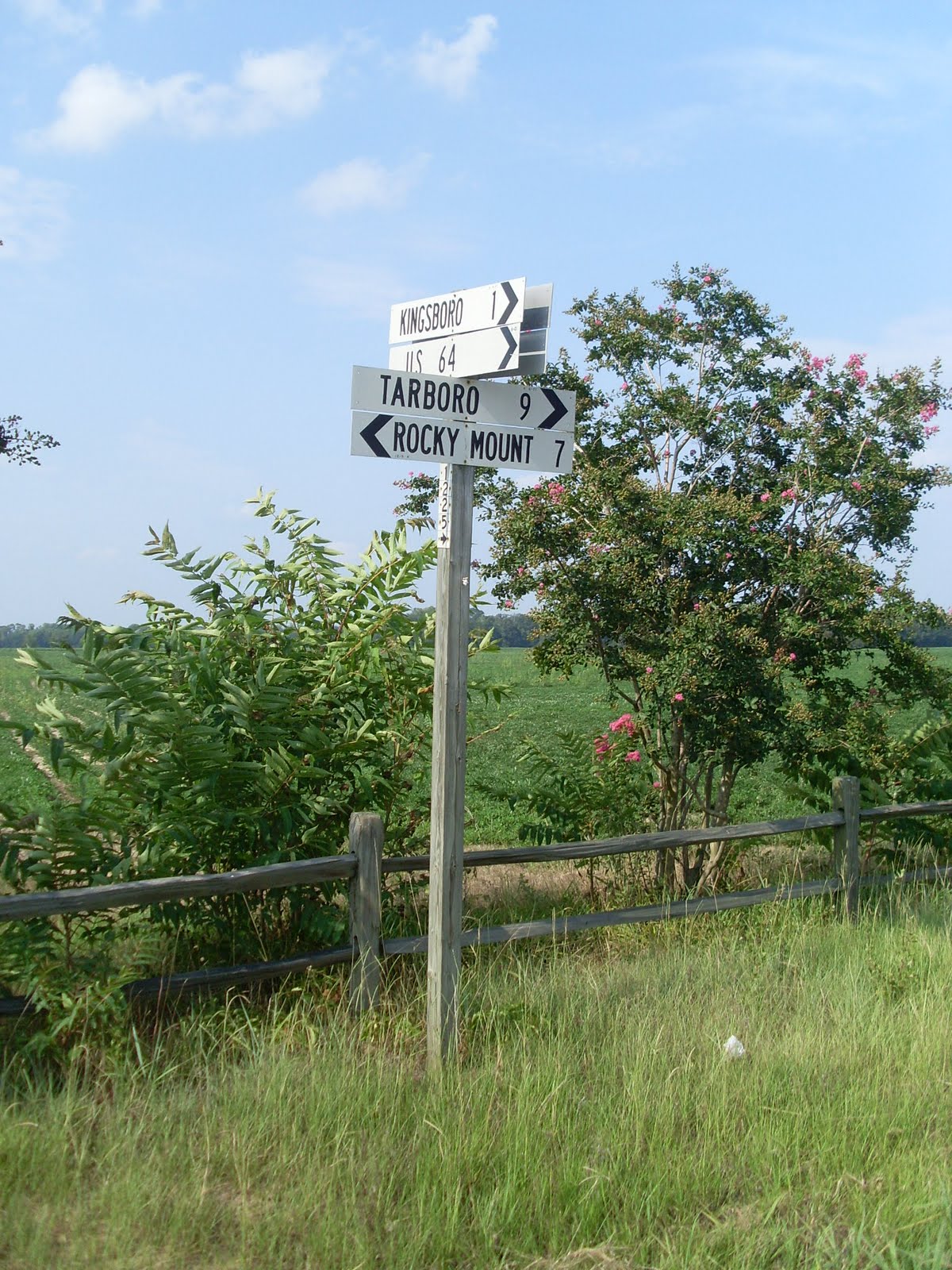
To add injury and insult to, um, something, my water pump failed in "east boondocks North Carolina". We spent 5 hours and a couple hundred dollars getting it towed to Rocky Mount and repaired. The repair shop was just a few blocks from downtown Rocky Mount, so we had a little time to walk around and explore. There, we discovered a grand, historic train station that served 9 or 10 trains a day! It was right on the New York-Florida line. Just as we walked up, a couple of guys were bicycling away from the station. And a train to Florida was coming through in 30 minutes. Boy was it tempting to hop on board! But no, instead we had to head back to the garage, get the car, and drive until 5 in the morning.

Wednesday, July 28, 2010

Parking - It's All About Location

One benefit of cycling is that you can park almost anywhere. You don't have to pay for it, you don't have to circle the block waiting for a spot to open, and you don't have to waste valuable time wandering around in some creepy parking garage.

Unfortunately, many businesses are unaware that their customers and employees may be arriving by bicycle and expecting to find convenient parking close to the front door. Some places can't even tell you where the closest parking is located. In other cases, they direct you to a poorly-designed rack (see yesterday) buried inside a parking garage at least a block away. This defeats the purpose.

It can also discourage ridership overall. I know one woman whose commute, in the city of Decatur, is less than a mile. She is very interested in bicycle commuting, and makes other trips by bike. However, the closest designated bicycle parking is over two blocks away from her office, but she has a free parking space in a garage directly under her office building. She has a hard time justifying the change - the bicycle trip itself wouldn't add any noticeable time to her commute, but it is almost twice as long with the time spent walking back from the bike rack. Shouldn't it be the other way around?

Georgia State University is notorious for this. When I went there for an admission interview, some years ago now, I was nearly late because I couldn't find the bike parking. [Side note - the only place I've ever seen signs directing you to bike parking in Atlanta is at Lindbergh Station.] Of course, GSU's parking was in this garage under the library. At that time, there were about 6 racks for the entire main campus, and two others near the Aderhold/Rialto area. I have to say that a couple of champions there have managed to get quite a bit more parking installed, but there is still room for improvement.

In Little Five Points, cyclists favor this railing in the center of Findley Plaza to the bike racks a block away in either direction.


A parking rack in front of Java Monkey, also in Decatur, is filled to overflowing.

Another shot from my trip to Buckhead. This development was on a bike lane and housed several desirable restaurants, including a Flying Biscuit location. There was a large plaza that clearly tried to evoke some walkable European heritage. An enormous driveway, valet service, a lofty arcade, benches and statues. But no apparent bicycle racks. After several inquiries, we wound up at a bad rack in the garage. (Look closely in the second picture. I swear it's back there!) You couldn't even ride to it - you had to dodge the entry gate cross into the exit lane (against traffic flow), and hoist your bike up a steep curb. There is no pedestrian entry, so you can't walk your bike in from the plaza. Really, would it kill them to put some racks somewhere out in the vast plaza area? Are parked cars somehow more scenic than a row of bicycles?
I'll wrap up with a good example from Trees Atlanta. I disagree with some of their other practices, but they got the parking right at their headquarters. This rack neatly handled a passel of fully-equipped bikes, and there were several more racks a few feet away. And, equally importantly, they were installed far enough from the wall, allowing the bicycle frames to be centered on the rack without turning the front wheel.

Friday, July 2, 2010

Bicyclists Behaving Badly

It's time to discuss traffic behavior again. There seem to be a lot of new cyclists on the road, plus the usual suspects, and a whole lot of excuses and misinformation.
If you talk about bicycles with any non-bicycle-riding person, you will certainly hear stories of cyclists they encountered who ran red lights, snuck to the front of the line of traffic, etc. Many people think that bicycles are not only allowed, but supposed to ride on sidewalks. Any news story about bicycling is followed by angry comments about lawless bicycle riders. People ask me if cyclists are supposed to stop at traffic lights. Now, there are plenty of traffic infractions going on at any time, it is entirely true that a large percentage of cyclists routinely break traffic laws.

This breeds hostility and confusion. I've been delayed at four-way stops as all traffic comes to a halt because they don't know what I, on my bicycle, am about to do. I've seen drivers run stop signs ahead of me, because they are expecting me to do the same. I've nearly been hit riding my bike through a green light, by some other cyclist who was running the red. I've had to swerve out of my lane because someone is riding the wrong way towards me. I've nearly been hit by bicyclists while walking down the sidewalk.

Sure, some people who ride bicycles think they're part of some special subculture. Whatever. Or they think that past confrontations entitle them to base their traffic operations on their own judgment rather than law. I've heard all the excuses. Some people have elaborate explanations about the justification for their actions.

Well, if you do care about anyone who else who rides a bicycle, or if you think there is any hope for Atlanta to become safe and pleasant for cycling, then start riding legally, now. No excuses.

For all the hundreds of polite drivers you encounter when riding a bike, it's the one jerk that you remember. Same for drivers - they remember the one inconsiderate cyclist instead of the ones who are riding courteously and legally. If bicycle riders, as a whole, are seen by the general public as a routine part of traffic, we will see huge gains in road safety. I don't want to offend anyone here, but trust me, I experience this every day. I'm predictable, law-abiding, and friendly, and get treated with an abundance of patience and respect. I would be thrilled if other people could experience Atlanta's streets the way I do.

Here, once again, are the basics:
  • A bicycle is a vehicle.
  • A person riding a bicycle must follow all of the same laws that apply to driving a car - obeying traffic signals and stop signs, merging and turning safely from the correct lane, stopping for pedestrians where required, and travelling in the roadway in the same direction as any other vehicle. If you shouldn't do something in a car, don't do it on a bicycle. Don't ride on the wrong side of the street or the wrong way on a one-way street. Don't go straight from a right turn lane. Don't stop in the crosswalk. Don't pass on the right or try to share a lane if there isn't enough room.


 There are a few rules specific to bicyclists...
  • Bicycles are doubly prohibited from riding on the sidewalk under two separate state laws. Riding on the sidewalk is not safe, because drivers don't expect anything on the sidewalk to be going faster than, say, 3 miles per hour. They don't look for you on the sidewalk when they are pulling out of a side street or turning off the main road. The sidewalk is where a large percentage of crashes happen. It also scares and endangers pedestrians.

  • Children 12 and under are permitted to bicycle on the sidewalk. Children are theoretically biking at an adult walking pace, which is why they are allowed here. A proficient child cyclist who will be riding at an adult cycling pace should switch to the road.
  • Bicycles operated at night must have a front headlight and rear reflector. I recommend a bright taillight, and don't skimp on it. Mount lights thoughtfully and then have a friend ride your bike down the block and back so you can see how it looks from a distance. Blinking lights may get attention but solid lights are more likely to indicate "moving vehicle" to others on the road.
  • Bicycles may operate in bike lanes and on marked shared-use paths, and may not operate on certain roads where non-motorized vehicles are explicitly prohibited (although there is some debate over the legality of this).
  • Bicycles may not ride more than two abreast. I'm not sure why - we may need to challenge this as we get better and wider bicycle infrastructure. After all, it seems like a big waste of capacity to have only two bikes in a 10 or 12 foot lane.
  • Cyclists should take the lane if it is not wide enough to share. There is no exact definition for a shareable lane; I would say 15 feet minimum. If it is wide enough to share, you are supposed to stay to the right of the lane to the extent it is safe to do so. That means staying far enough from the edge of the road to avoid uneven pavement, gravel, tree branches, etc. It means riding at least 3 feet out from parked cars so you can safely avoid open car doors. Cyclists should change lanes or lane position in order to pass slower traffic - always pass on the left - or to make a left turn, merge, etc.

Tuesday, April 20, 2010

Women for Cycling

A few of Atlanta's female cyclists and transportation leaders met on Sunday to talk about cycling promotion. Well, when I say transportation 'leaders', I mean the director of the Atlanta Bicycle Coalition, the regional bicycle planner, and me. Women hold a number of other influential transportation positions in the Atlanta region (from the director of MARTA to the city transportation planner), so we hope to hold future meetings with a larger group. Brunch was followed by a short field trip to see a new "art" bicycle rack.
Rebecca and Lyuba discuss a new bicycle rack installation at Georgia State University
While eyecatching, the rack had very few places to securely support and lock a bicycle, especially with racks or fenders mounted.
Why women? The question I often get is, why should we worry about this? There are so few cyclists in Atlanta, compared to other places, shouldn't we worry about total numbers rather than these little details? But that's the point. If women rode bicycles at the same rates as men, total ridership numbers would nearly double. Well, in most cities. Actually, Atlanta looks pretty good in this respect. Measured ridership in 2008 was about half a percent for both men and women (figures from the 2008 American Community Survey -see link for more info).

Other reasons include equity and social justice, the potential influence over kids (the next generation of bicycle riders), and the idea that true bicycle culture can't evolve unless everyone can do it. If women don't feel comfortable riding under current conditions, what about children and the elderly? Ironically, TV and print ads that show bicycles tend to show female riders. This seems to signal a safe and pleasant community.

Expanded ridership also brings cycling into a social realm. Can you ride with your friends, family, or colleagues? If three people want to go out to dinner by bicycle and the fourth person objects, the whole group may default back to driving. Also, many women approach me with questions about clothing, children, and personal safety. I'm always happy to share my opinions, but we also need a more permanent resource.

However, the simple desire for safe, equitable, and efficient multimodal transportation is still seriously misunderstood. A little controversy erupted recently over national transportation commissioner LaHood's recent suggestion that USDOT stop marginalizing pedestrian and bicycle travel. The arguments bordered on silly - are we going to start shipping freight by interstate backpack? They were also clearly misinformed. For one thing, a significant amount of freight transport does occur by 'alternative' modes - think of freight rail, postal routes on foot, bicycle couriers, or the light vehicles (from ATVs to golf carts) used on farms and campuses.

More seriously, these arguments fail to acknowledge serious problems in the current transport system that do affect efficiency, economic stability, and even the trucking industry. Freight trucks all over the country contend with traffic every day. Sometimes they get stuck in hours of rush hour traffic, surrounded by motorists who might prefer to be on a commuter train or a cycle track - but there isn't one. Other trucks get stuck in line with hundreds of cars waiting to drop off or pick up children from school, that happens to be along the route to a distribution center or factory. Many of those children may live within a few miles of the school, easy cycling distance even for a child. But their subdivision and their school probably don't connect. If they're like most developments, they can only be accessed from the local major road or highway, and that road probably doesn't have a sidewalk or bicycle facilities. So even though it is in cycling distance, they would have to go out and ride their bike on a busy highway with trucks and high-speed traffic. 

So no, equalizing bicycle traffic does not mean eliminating motor vehicle facilities. Actually, it means enabling trips to be made by the most efficient mode possible. For many short personal trips, that may be cycling, walking, or heading over (by whatever mode) to the transit station. And many freight trips can continue to be made by foot, bike, or train as well. Maybe some urban deliveries will be taken up by light vehicle - which is okay...who wants to navigate a semi truck downtown anyway? And all those freight trips that are an appropriate distance and location for trucking can be made more safely and efficiently, drivers' time on the road can be more predictable and less frustrating. Crazy, huh?

So, we'll keep meeting, keep explaining, and keep pedaling until our trips are taken as seriously as any other.
Posing with Rebecca and Everett (in the trailer)

Friday, April 2, 2010

Attack of the Interstate Highway System

Although I don't ride my bicycle on the Interstates - obviously - they still affect every trip I make. Atlanta and the State of Georgia chose to run three major highways through the city. I-75 and I-85 run together part of the way, and intersect with I-20 just a few blocks south of downtown Atlanta. They have been widened multiple times, and other limited-access highways have been added over time. This not only impacted the properties and streets that were bulldozed for highway construction, but much of the surrounding street network as well. Roads leading to highway entrance and exit ramps were converted to one-way streets, widened, and given priority over cross streets. Speed limits were raised and city streets were annexed by the state government.

The results are obvious. Scanty traffic barrels down wide, empty roads, which are preserved as a backup system in case the Interstate (almost a mile away) fails. Of course, the city street network is much more robust than the single-corridor highways, and does not need such enormous roads to handle traffic. But I doubt the engineers realize that.
Many streets are nearly vacant at rush hour, which encourages speeding

Elsewhere, road segments suffer from gridlock and congestion - but only for 5 or 10 blocks around the entrance and exit ramps. A cyclist has to fight her way through this mess along with everyone else, but is rewarded with car-free streets on the other side. I encounter at least three of these highway knots on my route to and from work. Most of the bottlenecks cannot be avoided, because all of the alternate routes have been eliminated in highway construction.

It is the most inefficient, stressful, and unsafe system you could possibly imagine.

 Blue Belle shakes her head basket sadly at gridlock near the Williams Street ramps

Thursday, March 25, 2010

The [Other] Joys of Stopping with Your Bicycle

The spring cyclists are out, and I have to be a little bit critical. I stop at red lights. I have been seeing soooo many people who don't. I know that this is a very contentious topic. But I think, if we expect cars to obey traffic laws and respect our right to the road, then we should comply with traffic laws too. I passed four cyclists on my way to work this morning - and three of them were the same guy. I passed him, and then he ran the light, and then I passed him again and so on. It's no skin off my back, unless you run a light or stop sign when I have the right-of-way. Then I'll yell at you.

Nonetheless, I'm still happy to be seeing more cyclists on my route. This is the guy I only saw once...

Wednesday, February 17, 2010

Strict Liability

I'm feeling a little cynical today. The morning started with a news report on NPR about backlash against red light cameras in Arizona. That reminded me of an article I read recently about a study of bicycle collisions in Fort Collins, CO, and the insensitive comments that readers made about it. The readers (most of whom had obviously forgotten how to travel without their car) had two points in common:
1. They seemed to be in favor of bicycle infrastructure
2. They seemed to think that the burden of crash prevention fell entirely to cyclists, since bicyclists were more likely to suffer injuries.

There is an ongoing debate over the justification for bicycle infrastructure. Many motorists are in favor of completely separated bicycle paths. They think that this would reduce "delays" for motor vehicle traffic. In truth, it probably wouldn't, unless it were a really lousy system. In a sense, it would double the number of intersections, and might lead to right-on-red restrictions where there are leading bicycle traffic signals. Some cycling advocates fear that over-reliance on separated facilities could lead to bicycles being banned from public streets. Such a system would be a far cry from the celebrated infrastructure of Amsterdam and Copenhagen, where bicycles not only have their own infrastructure, they are also exempt from many motor vehicle restrictions such as plazas and one-way streets.

But Amsterdam, Copenhagen, and many of their neighbors have success with bicycle traffic, and safety, for another reason: Strict Liability. This policy holds that the motorist is almost always at fault if they are involved in a collision with a bicycle, pedestrian, or other unarmored traveler. The assumption is that, if we, as a society, are going to permit you to operate a powerful piece of machinery in public, we can at least expect you to do so with the utmost level of caution. Really, where else in your life will you be given such lethal power to exercise around your fellow citizens on a daily basis? When we drive, shouldn't we behave as though we're holding a loaded gun?

But we don't. I think we are all collectively suffering from "freeway-itis". This is the belief that the world outside is just a hostile expanse of almost-lawless pavement, where other people are willing to kill you just to beat you to the exit ramp. In this "Mad Max" world, the logical response is to armor your vehicle and leave home with a defensive, competitive mindset. Other road users are just opponents, and civility is abandoned.

It may take a long time to really overcome this. It will take more than adding bicycle paths to the existing semi-functional system. We actually have to redesign the entire system to reintroduce humanity into every mode of transportation. We need to take traffic violations seriously, as an intentional threat to human life and public safety, with the penalties to match. We need to think of our streets as indicators of public culture. Are our children safe there? Are the elderly at liberty to travel and take part in daily life? Are the streets a place for people and life, or a source of stress, fear, and frustration?

Sorry for the ranting... I try to limit myself to no more than one rant every few weeks. I'll be shiny and happy again tomorrow, I promise!