Just in time for peak retail season, I want to take a deep look at the effects of car parking. I'm not the supreme expert on this - that would be Donald Shoup - but I do read a lot of research studies. Unfortunately, these studies have been no match for the Fear of Not Finding a Parking Space.
As a bicycle rider (and occasional driver), I can certainly sympathize with parking anxiety. After all, car parking spaces probably outnumber bicycle parking by twenty katrillion to one. I often think ahead about the parking conditions at my intended destination, and adjust my travel accordingly. And that's the point.
Parking options have a huge impact on travel choices. When you know there will be plenty of free parking where you are going, hopping in the car seems like the easiest choice - in fact, preferable to walking or bicycling across a huge parking lot. Let's say you are meeting a friend somewhere for dinner. If there is lots of free parking there, maybe you will both drive and meet each other there. Now suppose there is parking available, but you have to pay for it. That might inspire you to pick your friend up on the way and split the cost. Next, suppose that you will have to pay for parking, and you will have to hunt around for several blocks to find an open space (on the street or in a garage). At this point, you might start to wonder if there are other ways to get there - isn't there a train station a few blocks away, or maybe I could try that new bike path?
The opposite psychological effect is true too - if you take transit somewhere but have to walk past several parking lots to reach your destination, you might think that it would be easier to drive next time. Of course, if your city is just building low-density strip malls, office parks, and disconnected subdivisions, parking doesn't have a huge impact because the alternatives to driving are so poor anyway. But if they are trying to do a little smart growth or transit-oriented development, parking has to be on the table, for the above reasons and more. The situation in Atlanta where parking is now raising its head is in the development codes for the BeltLine.
Minimum parking requirements can be found everywhere. Even the city of Houston, which does not use zoning in the traditional sense, still mandates how much parking has to be provided for each type of residence, store, restaurant, business, etc. In the debate over government regulation versus free-market activity, parking is a doozy. A grocery store developer may have to purchase 4 times more property than the actual footprint of the store in order to build the mandated amount of parking. It's an enormous financial burden on businesses and the construction industry, and it ultimately forces them to give away, for free, something that has inherent value.
Parking requirements are generally based on peak usage, as calculated by some relatively limited studies. And by limited, I mean they looked at a handful of locations, maybe a few decades ago, maybe somewhere in suburban southern California, and then they require that much parking for a store in Buckhead relative to square footage, or number of seats, or whatever. It's neither scientific nor context based, but it is universal. The result is that, except for a couple of days before Christmas, we have waaaaay too much parking. And there is very little flexibility in these requirements. If you build a bar next to an office building, they each have to have enough parking for their peak usage, even though their peak hours occur at different times and they could easily share the same supply of parking.
Since each property has to provide its own proprietary on-site parking, property owners get very protective of its use. So if you drive to the store, and then want to eat at the restaurant right next to it, you may have to drive there or risk getting booted by the store's security force. Of course, property owners have a lot of incentive for being so possessive - parking spaces are expensive! You have to buy the land for them, and construct them, and if land is expensive you can build a multi-story parking structure at great expense. The figures I've heard for the price of each parking space is about $8,000 for an onstreet space in a nice residential neighborhood, about $10,000 for a surface lot space, and $30,000 to $50,000 for each space in a parking garage. The developer (or the department of transportation, for onstreet spaces) spends a ton of money to build that mandated parking, but guess what - they can't recoup their costs directly. Why? Remember Econ 101? We've mandated a huge oversupply of parking, and when supply greatly exceeds demand, prices drop to almost nothing. We have a parking glut.
Of course, developers don't just take a loss on all of that expense. They pass at least some of it on to their buyers or tenants. If it's commercial property, those costs show up in your bill, even if you walked there. If you buy a condo, you can't say "I don't need those parking spaces, so knock $60,000 off the selling price, please." We all subsidize those parking spaces, even if they are sitting empty.
We subsidize them in another way, too. Since there is no functioning market for parking, all of those spaces are effectively non-revenue generating. Think about what that means for the tax base. If 10%, or 50%, or 80% of each parcel is occupied by free parking, you are taking that much land out of the picture for development. If you can only develop 50% of your city's buildable land, rather than 100%, then you have to raise everyone's taxes in order to pay for the same mileage of roads, sewer lines, police patrols, etc.
Eliminating parking requirements would not mean an end of parking. It would just revert parking provision to the free market, and it would be a very gradual process to boot. There are only so many new developments that go up each year; existing properties really wouldn't be affected. But imagine the new scenario - a developer wants to build 100 units of residential property in a new five-story development. In the past, she would have been forced to build 200 parking spaces along with it (on average). Now, she can undertake her own research to determine how many parking spaces she actually thinks are needed. She sees that there is a bike path, shopping district, good sidewalks, and several transit lines (bus and rail) nearby, so she thinks that many of her residents will only own one car and that their guests will only drive 50% of the time. So, she can already save some money on parking. But then, a local parking company approaches her, and says they heard about her development and a couple others in the area, and that they would like to provide the parking facilities. Now, the parking company may use or refine parking projections from the residential developer and other proposed projects. The developer does not have to build or sell parking spaces at all; she can sell her residential units at a lower price point and offer buyers the opportunity to purchase one or more parking spaces in the new garage a few doors down. Buyers have more control over their transportation options and local businesses see a little more foot traffic. These changes will be especially important in a district like the BeltLine, where residents and businesses may already be paying a locational premium to be near the transit, trails, parks, and stores planned for this area, and who may intend to use the BeltLine instead of buying a car (or a second car).
One of the big fears about elimination of parking requirements is that developers will underbuild parking, and that this will result in shoppers or office workers filling up residential onstreet parking instead. There are two perspectives on this. On the one hand, you can offer residential parking permits or a similar mechanism to prohibit parking on residential streets. On the other hand, you can ask whether it is advantageous to reserve onstreet parking for local residents (and I say this as a homeowner in a mostly-single family neighborhood adjacent to the BeltLine). After all, you buy or rent the home, not the public street in front of it - the parking spaces themselves are paid for with a mix of property taxes, local sales taxes, and some gas taxes. Most people have room to add more parking to their lot if they are willing to give up some of their yard for it. Older neighborhoods may not have consistent off-street parking, but they could have alleys and decent access to transit, bikeable destinations, and sidewalks. One could also argue that by provided so much free parking to residents, we are simply enabling them to store unnecessary personal property at public expense (rarely-used second or third cars) and discouraging them from exploring other transportation options.
These ideas need to be discussed if we are going to successfully redevelop Atlanta, or anywhere, for walkable, bikeable development. There is a lot of confusion and some deep-seated fear of change. I highly recommend that you find a copy of The High Cost of Free Parking and read if from cover to cover before attending your next public meeting - you'll never see the city the same way again!
Showing posts with label parking. Show all posts
Showing posts with label parking. Show all posts
Thursday, December 1, 2011


Sunday, November 14, 2010
Meanwhile, back in Atlanta
My trip to New York gave me a lot to think about, but I was really only there for a couple of days. Life back in Atlanta has been pretty routine. Riding to work, finding creative places to lock a bicycle at interesting new (and old) drinking establishments, oiling chains and trying to rearrange the house so there will be enough places to squeeze in a bike or two. There were a couple of days when I hardly saw anyone else on a bicycle, even though the weather was lovely. Then there was the Chomp and Stomp in Cabbagetown last weekend (yes, I am a week behind in postings!).
It really goes to show how important location is for bicycle culture. I saw that in NYC too. There are certain neighborhoods where cycling becomes really popular, even in the midst of a city with minimal bicycle mode share. Part of it may be due to young, trendy residents picking up on trends from elsewhere - fixed-gear aficionados and celebrity sightings. But it seems to follow the infrastructure as well.
Both Little Five Points and East Atlanta, where bicycle culture seems to congregate, have good bike lanes connecting them to the downtown area (Edgewood Ave. and Glenwood Ave., respectively). They also have a pretty good network of local streets that allow bicycle riders to get around the neighborhood on quiet, low-speed side streets. They also have small commercial centers that make it possible for local residents to meet their daily needs without going across town. Now if you could just connect those two neighborhoods with a bike lane on Moreland Ave., we'd be all set!
The point is, if you hold a funky festival in the midst of these bike-happy places, you get a whole lot of bicycles. Atlanta Bicycle Coalition set up a bike valet station to provide free bicycle parking (donations welcome), and it was full up. I can't even guess how many hundreds of bikes came through there that day. And there were still many more who didn't make it over to the valet at all.
It really goes to show how important location is for bicycle culture. I saw that in NYC too. There are certain neighborhoods where cycling becomes really popular, even in the midst of a city with minimal bicycle mode share. Part of it may be due to young, trendy residents picking up on trends from elsewhere - fixed-gear aficionados and celebrity sightings. But it seems to follow the infrastructure as well.
Both Little Five Points and East Atlanta, where bicycle culture seems to congregate, have good bike lanes connecting them to the downtown area (Edgewood Ave. and Glenwood Ave., respectively). They also have a pretty good network of local streets that allow bicycle riders to get around the neighborhood on quiet, low-speed side streets. They also have small commercial centers that make it possible for local residents to meet their daily needs without going across town. Now if you could just connect those two neighborhoods with a bike lane on Moreland Ave., we'd be all set!
The point is, if you hold a funky festival in the midst of these bike-happy places, you get a whole lot of bicycles. Atlanta Bicycle Coalition set up a bike valet station to provide free bicycle parking (donations welcome), and it was full up. I can't even guess how many hundreds of bikes came through there that day. And there were still many more who didn't make it over to the valet at all.
 |
| Bicycle parking here! |
 |
| Parking this many bikes takes organization |
 |
| Rockin' the mixte (a unisex bicycle frame) |
 |
| I see about one tandem for every hundred bicycles or so |
 |
| On the far side of the festival, bikes were parked three deep |
Thursday, October 21, 2010
Health Versus Health Care
Riding a bicycle is good for your heart. I went to the doctor for an annual checkup the other day. Not to brag or anything, but my cholesterol levels are awesome. Super-good on everything. And I don't exactly have a healthy diet. I eat lots of veggies and whole grains, but I'm also a big fan of butter and bacon. I'd like to think that my daily physical activity, on the bicycle, is keeping me healthy.
I expect that most physicians would like to encourage their patients to be more active. All of the data I read shows Atlantans getting sick from heart disease and strokes and diabetes and other diseases that can be alleviated with exercise. So wouldn't it make sense for Emory Midtown medical center to promote cycling to their visitors?
 Apparently not. Here is just part of the building that houses the physicians' group, hospital services, and other medical offices. I didn't see the fire code rating, but I would assume that several thousand people can occupy this building at any given time. Guess how many of them will find bicycle parking?
About five. There is one standard bicycle rack for the entire building. It's in a good location, visible from the front door and valet stand (for security) and closer to the entrance than the car garage. That's great. Now you just need about a hundred more of them.

I did get a little smile from the bikes that I found sharing the rack with me - a classic and well-maintained Centurion mixte in this lovely shade of copper, and a new steel-framed Raleigh with fenders and a Brooks saddle.

I expect that most physicians would like to encourage their patients to be more active. All of the data I read shows Atlantans getting sick from heart disease and strokes and diabetes and other diseases that can be alleviated with exercise. So wouldn't it make sense for Emory Midtown medical center to promote cycling to their visitors?

About five. There is one standard bicycle rack for the entire building. It's in a good location, visible from the front door and valet stand (for security) and closer to the entrance than the car garage. That's great. Now you just need about a hundred more of them.

I did get a little smile from the bikes that I found sharing the rack with me - a classic and well-maintained Centurion mixte in this lovely shade of copper, and a new steel-framed Raleigh with fenders and a Brooks saddle.

Friday, September 3, 2010
Bicycle to the Braves
Last weekend, we got some cheap tickets to an Atlanta Braves game. I'm not much of a spectator sports fan, but it's fun once in a while. I scope out the crowd while The Beau cheers and does all of the special chants and gestures.

The stadium isn't far from my house, which makes it very convenient cycling distance. I would generally recommend bicycling there for any fan... The car traffic gets really bad and parking is super expensive. MARTA is a good way to go, but their buses get stuck in traffic sometimes, too. Walking or cycling to the stadium from Georgia State station is probably the second best alternative, if you live far away. The advantage of bicycling is that you can zip past traffic in the nearby bike lanes, bypass all of the barricades around the stadium entrance, and park at the front door. It's about 5 minutes from downtown Atlanta and 15 or 20 minutes from Midtown.

However, we discovered a problem with parking at the front door. Yes, the racks are horrible "wheel-benders" that you can barely get a U-lock around. Yes, there are only about 20 parking spaces for a stadium that seats 50,000. But the worst part is that they block off the area around the bicycle racks for the Friday night fireworks show. So, you have to leave before the game is over or you're stuck there for the next 30 minutes. There is one small sign that tells you this, but it was nowhere near the rack where The Beau and I were parked. In fact, I think it was hidden behind a promotional booth. Fortunately, an understanding security guard let us grab our bikes moments before the fireworks display started. About a dozen other cyclists weren't so lucky.
 If Atlanta ever wants to get serious about bicycle parking, this is a good place to start. It could make car traffic and parking less burdensome on local residents. And it would be good for redevelopment in the area. No one should have to park like this at a major public attraction.


The stadium isn't far from my house, which makes it very convenient cycling distance. I would generally recommend bicycling there for any fan... The car traffic gets really bad and parking is super expensive. MARTA is a good way to go, but their buses get stuck in traffic sometimes, too. Walking or cycling to the stadium from Georgia State station is probably the second best alternative, if you live far away. The advantage of bicycling is that you can zip past traffic in the nearby bike lanes, bypass all of the barricades around the stadium entrance, and park at the front door. It's about 5 minutes from downtown Atlanta and 15 or 20 minutes from Midtown.

However, we discovered a problem with parking at the front door. Yes, the racks are horrible "wheel-benders" that you can barely get a U-lock around. Yes, there are only about 20 parking spaces for a stadium that seats 50,000. But the worst part is that they block off the area around the bicycle racks for the Friday night fireworks show. So, you have to leave before the game is over or you're stuck there for the next 30 minutes. There is one small sign that tells you this, but it was nowhere near the rack where The Beau and I were parked. In fact, I think it was hidden behind a promotional booth. Fortunately, an understanding security guard let us grab our bikes moments before the fireworks display started. About a dozen other cyclists weren't so lucky.


Monday, August 16, 2010
Bike Racks are for Bicycles
My office got an email from Georgia Tech facilities management the other day, warning that all motorcycles, mopeds, and other motorized vehicles would be aggressively ticketed for parking on the sidewalk or at a bicycle rack. I haven't had any issues at my building, but I've seen lots of problems elsewhere. A few misplaced scooters, and the bicycle parking can become completely inaccessible. I hope sufficient parking for motorcycles and scooters will be provided around campus - they are not lower in emissions in cars, but they are more fuel-efficient and much nicer to share the road with than a big SUV! But I'm also glad that parking regulations are being enforced and bicycle parking is protected from encroachment.
 |
| Parking violation |
Friday, July 30, 2010
Parking. Will We Have Enough?
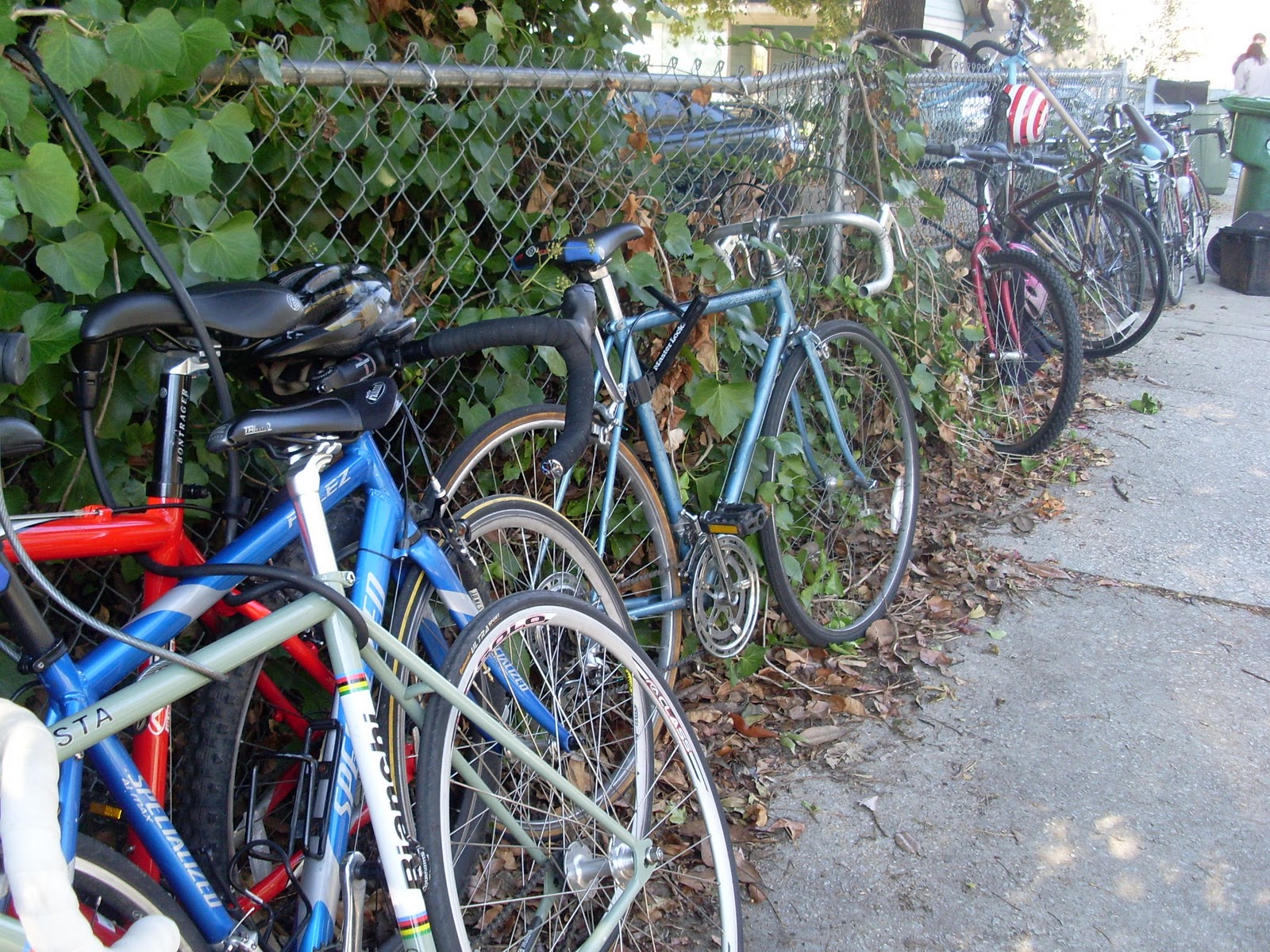
Final thoughts on bicycle parking... One way I judge the increase in bicycle ridership is by the number of bikes I see parked. Lately, it seems like every rack I see is full (not to mention trees, signposts, and the like). At Georgia Tech, school is out for the summer but nearly every spot is taken at the racks, and only a few spaces are left on the street. What will happen when classes start up in the fall?
 I've parked at the rack at Peachtree Center a number of times in the past, and I was the only one there. These days, it's nearly full with roadsters and smart commuter bikes (and the occasional scooter). Same with the secure racks inside various MARTA stations.


And that's where we are now, in the dog days of summer, with half the city seemingly on vacation. What happens if more and more people start riding? Is there an impending bicycle parking crisis in the future?


And that's where we are now, in the dog days of summer, with half the city seemingly on vacation. What happens if more and more people start riding? Is there an impending bicycle parking crisis in the future?
Wednesday, July 28, 2010
Parking - It's All About Location
One benefit of cycling is that you can park almost anywhere. You don't have to pay for it, you don't have to circle the block waiting for a spot to open, and you don't have to waste valuable time wandering around in some creepy parking garage.
Unfortunately, many businesses are unaware that their customers and employees may be arriving by bicycle and expecting to find convenient parking close to the front door. Some places can't even tell you where the closest parking is located. In other cases, they direct you to a poorly-designed rack (see yesterday) buried inside a parking garage at least a block away. This defeats the purpose.
It can also discourage ridership overall. I know one woman whose commute, in the city of Decatur, is less than a mile. She is very interested in bicycle commuting, and makes other trips by bike. However, the closest designated bicycle parking is over two blocks away from her office, but she has a free parking space in a garage directly under her office building. She has a hard time justifying the change - the bicycle trip itself wouldn't add any noticeable time to her commute, but it is almost twice as long with the time spent walking back from the bike rack. Shouldn't it be the other way around?
Georgia State University is notorious for this. When I went there for an admission interview, some years ago now, I was nearly late because I couldn't find the bike parking. [Side note - the only place I've ever seen signs directing you to bike parking in Atlanta is at Lindbergh Station.] Of course, GSU's parking was in this garage under the library. At that time, there were about 6 racks for the entire main campus, and two others near the Aderhold/Rialto area. I have to say that a couple of champions there have managed to get quite a bit more parking installed, but there is still room for improvement.

In Little Five Points, cyclists favor this railing in the center of Findley Plaza to the bike racks a block away in either direction.

A parking rack in front of Java Monkey, also in Decatur, is filled to overflowing.

Another shot from my trip to Buckhead. This development was on a bike lane and housed several desirable restaurants, including a Flying Biscuit location. There was a large plaza that clearly tried to evoke some walkable European heritage. An enormous driveway, valet service, a lofty arcade, benches and statues. But no apparent bicycle racks. After several inquiries, we wound up at a bad rack in the garage. (Look closely in the second picture. I swear it's back there!) You couldn't even ride to it - you had to dodge the entry gate cross into the exit lane (against traffic flow), and hoist your bike up a steep curb. There is no pedestrian entry, so you can't walk your bike in from the plaza. Really, would it kill them to put some racks somewhere out in the vast plaza area? Are parked cars somehow more scenic than a row of bicycles?

 I'll wrap up with a good example from Trees Atlanta. I disagree with some of their other practices, but they got the parking right at their headquarters. This rack neatly handled a passel of fully-equipped bikes, and there were several more racks a few feet away. And, equally importantly, they were installed far enough from the wall, allowing the bicycle frames to be centered on the rack without turning the front wheel.

Unfortunately, many businesses are unaware that their customers and employees may be arriving by bicycle and expecting to find convenient parking close to the front door. Some places can't even tell you where the closest parking is located. In other cases, they direct you to a poorly-designed rack (see yesterday) buried inside a parking garage at least a block away. This defeats the purpose.
It can also discourage ridership overall. I know one woman whose commute, in the city of Decatur, is less than a mile. She is very interested in bicycle commuting, and makes other trips by bike. However, the closest designated bicycle parking is over two blocks away from her office, but she has a free parking space in a garage directly under her office building. She has a hard time justifying the change - the bicycle trip itself wouldn't add any noticeable time to her commute, but it is almost twice as long with the time spent walking back from the bike rack. Shouldn't it be the other way around?
Georgia State University is notorious for this. When I went there for an admission interview, some years ago now, I was nearly late because I couldn't find the bike parking. [Side note - the only place I've ever seen signs directing you to bike parking in Atlanta is at Lindbergh Station.] Of course, GSU's parking was in this garage under the library. At that time, there were about 6 racks for the entire main campus, and two others near the Aderhold/Rialto area. I have to say that a couple of champions there have managed to get quite a bit more parking installed, but there is still room for improvement.

In Little Five Points, cyclists favor this railing in the center of Findley Plaza to the bike racks a block away in either direction.

A parking rack in front of Java Monkey, also in Decatur, is filled to overflowing.

Another shot from my trip to Buckhead. This development was on a bike lane and housed several desirable restaurants, including a Flying Biscuit location. There was a large plaza that clearly tried to evoke some walkable European heritage. An enormous driveway, valet service, a lofty arcade, benches and statues. But no apparent bicycle racks. After several inquiries, we wound up at a bad rack in the garage. (Look closely in the second picture. I swear it's back there!) You couldn't even ride to it - you had to dodge the entry gate cross into the exit lane (against traffic flow), and hoist your bike up a steep curb. There is no pedestrian entry, so you can't walk your bike in from the plaza. Really, would it kill them to put some racks somewhere out in the vast plaza area? Are parked cars somehow more scenic than a row of bicycles?


Tuesday, July 27, 2010
Parking - Nice Rack
Bicycle rack designs are awfully frustrating. The world is awash in racks that are nearly impossible to actually lock your bike to. I don't even understand why these things are manufactured. Some will hold your front wheel, but you can't get your frame close enough to use your theft-resistant U-lock, while leaving most of the bicycle unsupported so it falls over and gets damaged... Some racks are okay for a skinny racing-style bicycle but won't fit a commuter bicycle with racks, baskets, and fenders. Other racks have artistic features that make them hard to use.
Sevananda Natural Food Store recently spent money to have their parking lot repaved, but failed to upgrade their rusty old bike rack. This large rack really only provides two parking spaces, because the center section does not provide slots wide enough to slide a bicycle into, plus the crossbars are high enough to hit the bottom of your frame or fender. I'm not even positive that it is a rack, and not some sort of repurposed barrier. Guess I should have gone to the members' meeting to discuss priorities...
 The Buford Highway Farmers' Market suffers the same problem. You can see the difficulties cyclists had using it.

Georgia Tech invested in these double-T shaped racks. According to a diagram on the rack, you are supposed to hang your frame from it where the top tube meets the seat tube. But many of us have sloped or curved top tubes that don't fit over these things. Plus, a fully-equipped bicycle can be too heavy to lift that high, or put too much stress on that part of the frame. People use them creatively instead.


The best rack is always a staple rack, the ones that look like an upside-down U. It supports the frame and provides a variety of locking points, even if someone is parked on the other side. When you need more parking, you just install more of them. You can scatter them throughout a shopping district or provide long rows of them at major destinations. The renovated (and totally awesome!) pool at Piedmont Park got it right. They're going to need it - this array of racks was already half full when I visited the other day, and many people don't even know that the pool has reopened.

Sevananda Natural Food Store recently spent money to have their parking lot repaved, but failed to upgrade their rusty old bike rack. This large rack really only provides two parking spaces, because the center section does not provide slots wide enough to slide a bicycle into, plus the crossbars are high enough to hit the bottom of your frame or fender. I'm not even positive that it is a rack, and not some sort of repurposed barrier. Guess I should have gone to the members' meeting to discuss priorities...


Georgia Tech invested in these double-T shaped racks. According to a diagram on the rack, you are supposed to hang your frame from it where the top tube meets the seat tube. But many of us have sloped or curved top tubes that don't fit over these things. Plus, a fully-equipped bicycle can be too heavy to lift that high, or put too much stress on that part of the frame. People use them creatively instead.


The best rack is always a staple rack, the ones that look like an upside-down U. It supports the frame and provides a variety of locking points, even if someone is parked on the other side. When you need more parking, you just install more of them. You can scatter them throughout a shopping district or provide long rows of them at major destinations. The renovated (and totally awesome!) pool at Piedmont Park got it right. They're going to need it - this array of racks was already half full when I visited the other day, and many people don't even know that the pool has reopened.

Sunday, July 25, 2010
Parking - The Final Challenge
The bicycle infrastructure in Atlanta is seriously inadequate, but at least we know how we could fix it. There are good and bad examples from around the world. Not so with bicycle parking. Even cities that do a great job with bicycle traffic have very little on-street bike parking and never enough at high-demand sites, like train stations. Some cities are experimenting with giant bicycle parking decks, on barges, with valet service, or with automated racks that lift bicycles up onto tightly-fitted storage shelves.
Even with the small but growing amount of bicycling that we have now, it is clear that parking will be great challenge for Atlanta. Nearly every rack is full these days. City parking requirements for parking at new buildings are not enforced, and many of the racks that exist are poorly designed and in inconvenient or unsafe locations. What will we do if more and more people start riding?
Even with the small but growing amount of bicycling that we have now, it is clear that parking will be great challenge for Atlanta. Nearly every rack is full these days. City parking requirements for parking at new buildings are not enforced, and many of the racks that exist are poorly designed and in inconvenient or unsafe locations. What will we do if more and more people start riding?
Subscribe to:
Posts (Atom)


 Posts
Posts

